







Why Wellness and Sustainability Are a Business Strategy
When wellness and sustainability come up in a capital project, they are often filed under the same mental category as compliance – necessary, well-intentioned, and fundamentally a cost. Something the organization does because it’s the right thing to do, or because a stakeholder is asking, rather than because it delivers a measurable return.
This framing misses what these decisions actually do. Wellness and sustainability, designed into a space intentionally, are levers that affect productivity, retention, operating costs, and how the organization is perceived by everyone who encounters it.
Beyond Materials and Certifications
Sustainability in commercial design is frequently reduced to material selection – specifying finishes that are recycled or responsibly sourced, and checking a box. That work matters, particularly given how much waste the construction industry generates. But it is just the surface of a much deeper approach.
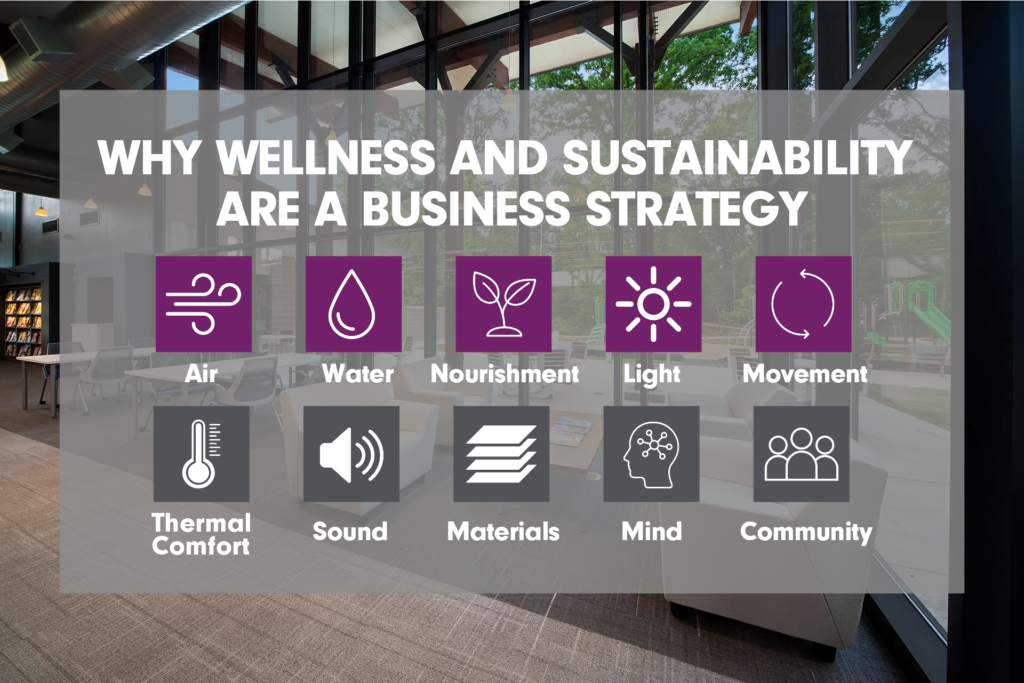
A more complete view considers the impact of a space across three dimensions: the people who use it, the community around it, and the environment it sits within. The goal is not simply to reduce harm through better materials, but to design holistically for a space that actively benefits the people inside it while minimizing its footprint. This is what credentials like the WELL standard are built around – moving past the question of what a building is made of to the question of what a building does for the people who spend their days in it.
Not every project needs to pursue a formal certification. Certification is an undertaking, and it is not always the right fit. But the underlying discipline – designing with the health of users, the surrounding community, and the environment held in view from the start – is something that belongs in every project regardless of whether a plaque goes on the wall at the end.
The Business Returns Hiding in Plain Sight
The reason to treat this as strategy rather than cost is that the returns are significant, even when they are indirect. A space designed for human wellness – with attention to air quality, natural light, acoustics, and the physical experience of spending eight or more hours inside – affects how well people work. Employees in environments designed around their health are more present, more productive, and more likely to stay. In a market where retention and talent attraction are persistent challenges, the physical environment is a quiet but consistent factor in whether people want to be there.
Sustainability delivers a parallel set of returns. Energy-efficient systems reduce operating costs over the life of the building. Durable, responsibly chosen materials last longer and require less replacement. And increasingly, clients and employees notice whether an organization is doing its part and the work space has become part of how a company is judged by the people who matter to it.
Designing for Today and Tomorrow
The most valuable version of this thinking connects wellness and sustainability to the longer time horizon of the building itself. The right approach considers not just what a space needs today, but what tomorrow looks like – how the building can be designed so that future shifts have a lesser impact, so that the organization is planning for change it knows is coming rather than being caught by it. Designing for wellness and sustainability is part of that longer view. A space built to support its people and tread lightly on its environment is a space built to remain valuable as standards rise and expectations grow.
For executive leadership, the reframe is simply that these values are not expenses to be minimized. They are investments that pay back through the productivity of your people, the loyalty of your talent, the efficiency of your operations, and the impression you leave on everyone who walks through the door.
If you’re ready to view wellness and sustainability as a strategic business advantage rather than a line-item cost, reach out via our contact page to schedule an early planning discussion.